
- by Mutunga
Why Nairobi homes experience repeated drain blockages (and how to stop it)
If you have had your drains cleared only to find them blocked again a few months later, you are not alone and it is not bad luck. There are six specific, fixable reasons this keeps happening in Nairobi homes. Here is the full picture.
Why the problem keeps coming back
Most Nairobi homeowners treat drain blockages like a flat tyre: something you fix when it happens and forget about until it happens again. But recurring blockages are almost never random events. They are symptoms of an underlying condition in your pipes that a quick plunger or a bottle of drain cleaner simply does not address.
The real frustration sets in after you have paid a plumber, everything runs fine for a few weeks, and then the smell returns or the water starts pooling again. That cycle of block, fix, repeat costs Nairobi households significant money every year and, in many cases, causes preventable water damage to floors, walls, and foundations.
Understanding the root causes is the only way to break the cycle. There are six of them, and they are all present in Nairobi homes to varying degrees.
6 Root causes of recurring blockages
Click each cause to expand the full explanation and prevention tips.
Grease and cooking oil buildup
This is the single biggest cause of blocked kitchen drains in Nairobi and the most misunderstood. When hot cooking oil, ugali water, nyama choma fat, or the residue from washing greasy pots goes down the kitchen sink, it feels harmless because it flows freely. The problem begins further down the pipe.
As the grease cools, it solidifies and sticks to the inner wall of the pipe. Each time more grease flows through, another layer coats the inside. Over weeks and months, the pipe’s internal diameter narrows, slowly at first, then dramatically. Eventually even water struggles to pass through.
Running hot water while pouring grease down the drain does not prevent buildup. The grease simply travels further down the pipe before solidifying, often in a section that is harder and more expensive to clear.
How to prevent grease blockages
- Allow cooking fat to cool and solidify in the pan, then scrape it into a bin bag before washing
- Keep a lidded jar near the cooker for small amounts of used cooking oil and dispose of it with solid waste
- Install a fine-mesh strainer in your kitchen drain
- Once a week, pour a kettle of boiling water slowly down the kitchen drain to help move early-stage grease deposits
Hair and soap scum
Bathroom drains face a different enemy: the combination of shed hair and soap residue. On its own, a few strands of hair down the drain seem insignificant. But hair does not dissolve in water. It tangles together inside your pipes, creating a net-like mesh that traps everything else that flows through.
Soap scum compounds the problem. Most bar soaps contain animal fats that react with the minerals in Nairobi’s water to form a sticky film on pipe walls. This gives the hair something to bond to, turning a loose tangle into a dense, stubborn plug.
How to prevent hair and soap blockages
- Fit a hair-catcher drain cover in every shower and bathtub (available in most hardware shops along Biashara Street for under Ksh 200)
- Clean the hair catcher every time you shower
- Switch to liquid soap where possible, as it produces far less scum buildup than bar soap
- Once a month, pour a cup of baking soda followed by a cup of white vinegar into the bathroom drain, let it fizz for 15 minutes, then flush with hot water
Tree root intrusion
This is the most destructive cause on this list and the one most often missed by basic plumbing checks. Nairobi’s lush gardens are beautiful, but the trees around them have root systems that extend far beyond what you can see above ground. Tree roots naturally seek out moisture and nutrients, and your sewer pipes are a perfect source of both.
Roots enter through tiny cracks, loose joints, or microscopic gaps in older clay or concrete pipes. Once inside, they grow rapidly in the warm, nutrient-rich environment. What starts as a hairline root becomes a branching mass that can completely fill a pipe, trap debris, and ultimately crack the pipe itself from the inside out.
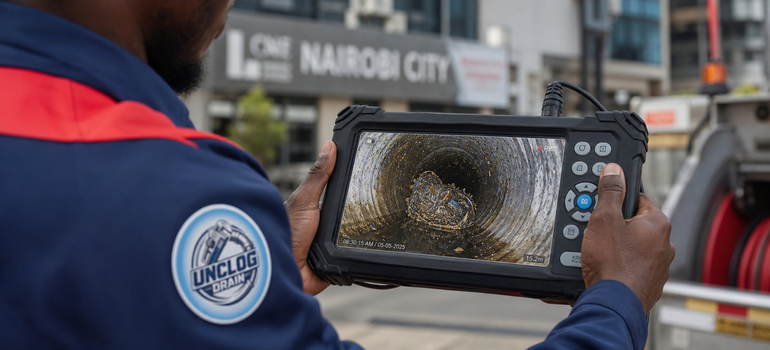
If your drain keeps blocking despite regular clearing, and you have mature trees or large shrubs within 10 metres of your sewer line, tree root intrusion is a strong suspect. The only definitive way to diagnose it is with a CCTV drain inspection.
A CCTV inspection takes less than an hour and costs a fraction of what root damage repairs cost when left too long. If your drain has blocked more than twice in 12 months with no obvious cause, a camera inspection is the smartest next step, not another rodding session.
How to manage tree root risk
- When planting new trees, choose species with non-invasive root systems and plant them at least 5 metres from any sewer line
- For established trees near sewer lines, schedule an annual CCTV drain inspection as a precaution
- If roots are found, professional hydro jetting can cut and flush them out
Nairobi’s hard water
Much of Nairobi’s water supply has a high mineral content, particularly calcium and magnesium, making it what plumbers classify as hard water. You may have noticed white or off-white deposits forming around your taps, on shower heads, or inside your kettle. Those same mineral deposits form inside your pipes.
Over time, these calcium and magnesium deposits (called limescale) build up on pipe walls and steadily reduce the internal diameter. Limescale is hard, brittle, and difficult to remove once established. It also creates a rough surface inside the pipe that catches grease, hair, and debris, dramatically accelerating blockage formation.
How to reduce hard water damage
- Consider fitting a whole-house water softener at your mains inlet
- Run a monthly maintenance flush with a diluted citric acid solution to dissolve early-stage scale
- Have your pipes professionally descaled every 2 to 3 years. Our drain cleaning service includes descaling treatment
Outdated or undersized pipes
A significant proportion of Nairobi’s older housing stock, particularly estates built from the 1970s through the 1990s in areas like Eastlands, South B, South C, Ngong Road, and parts of Westlands, were built with pipes that were undersized even for the households of that era, let alone modern usage levels.
Many of these properties have since been extended, subdivided, or had additional bathrooms added without any upgrade to the main sewer line. The result is a pipe system handling two or three times the waste volume it was designed for.
Signs your pipes may need upgrading
- Multiple drains in the house slow or block at the same time
- Gurgling sounds from toilets when you run the sink or washing machine
- The property is more than 25 years old and the sewer line has never been replaced
- Recurring blockages despite regular professional cleaning
A CCTV drain inspection will confirm the condition of your pipes and tell you whether cleaning, relining, or replacement is the right course of action.
Flushing the wrong things
Nairobi’s drainage system faces a significant challenge from materials being flushed that simply do not break down in water. The most common offenders found in Nairobi sewer lines include wet wipes (even those labelled flushable), sanitary pads, nappies, thick paper towels, and food scraps flushed from kitchen sinks.
These materials do not dissolve. They accumulate at bends in the pipe, catch on any roughness or partial blockage that already exists, and build into dense masses that completely obstruct flow.
The only things that should go into a toilet are human waste and toilet paper. Everything else, without exception, belongs in a bin.
When DIY solutions make things worse
There is a place for home remedies. The baking soda and vinegar treatment is genuinely useful for light maintenance, and a plunger will shift a simple surface blockage. But there are situations where DIY approaches do not just fail to help, they actively cause damage.
Chemical drain cleaners, the acid or caustic soda-based products sold in hardware shops and supermarkets, are the biggest risk. They can dissolve light organic material but do nothing for grease plugs, root masses, or scale buildup. More importantly, repeated use weakens older PVC and clay pipes, softens seals and joints, and corrodes metal pipes from the inside.
When to call a professional immediately
- Multiple drains in the house are slow or blocked simultaneously
- There is sewage smell inside the house, particularly from floor drains
- You can see or smell sewage backing up from any drain
- The same drain has blocked more than twice in six months
- You hear gurgling from the toilet when water drains elsewhere in the house
Our team provides professional sewer and drain cleaning across Nairobi, with a 1 to 2 hour emergency response time and CCTV inspection capability to diagnose the real cause, not just the symptom.
Free drain maintenance checklist for Nairobi homeowners
Tick off items as you complete them. Print and keep inside a kitchen cupboard.
These items should never go into your drains or toilets. They cause blockages that are expensive to remove.
Still dealing with a recurring blockage?
Our team covers all of Nairobi: Westlands, Karen, Kilimani, Lavington, Embakasi, CBD and beyond. We use professional-grade hydro jetting and CCTV inspection to find and fix the real cause, not just the symptom. 24/7 emergency response available.